dielectric material

What is a dielectric material?
A dielectric material is a poor conductor of electricity but an efficient supporter of electrostatic fields. It can store electrical charges, have a high specific resistance and a negative temperature coefficient of resistance.
More about dielectric materials
Dielectric materials are poor conductors of electricity because they do not have any loosely bound or free electrons that may drift through the material. Electrons are required to support the flow of an electric current. The current flows from the positive to the negative terminal and, in the opposite direction, as free electrons that flow from the negative to the positive terminal.
Dielectric materials support dielectric polarization, which enables them to act as dielectrics rather than conductors. This phenomenon occurs when a dielectric is placed in an electric field and positive charges are displaced in the direction of the electric field, while the negative charges are displaced in the opposite direction. Such polarization creates a strong internal field, which reduces the overall electric field within the material.
Important considerations for dielectric materials
An important consideration for a dielectric material is its ability to support an electrostatic field, while dissipating minimal energy in the form of heat. This dissipated heat or energy loss is known as dielectric loss. The lower the dielectric loss, the more effective the substance is as a dielectric material.
Another consideration is the dielectric constant, which is the extent to which a substance concentrates the electrostatic lines of flux. Substances with a low dielectric constant include a perfect vacuum, dry air and most pure, dry gases, such as helium and nitrogen. Materials with moderate dielectric constants include ceramics, distilled water, paper, mica, polyethylene and glass. Metal oxides, in general, have high dielectric constants.
Properties of dielectric materials
These are the most important properties of dielectric materials.
Electric susceptibility
This refers to a relative measure of how easily a dielectric material can be polarized when subjected to an electric field. It also refers to the material's electrical permeability.
Dielectric polarization
This is the amount of electrical energy stored in the electric field when voltage is applied to it. Since it causes positive charges and negative charges to flow in opposite directions, it can nullify the overall electric field.
Electric dipole moment
The extent to which the negative and positive charges are separated within the system refers to the electric dipole moment. Atoms contain both positively and negatively charged particles and are arranged as dipoles in the material. Applying an electric charge creates a dipole moment. The relationship between the dipole moment and the electric field gives a material its dielectric properties.
Electronic polarization
Electronic polarization happens when the dielectric molecules forming the dipole moment are composed of neutral particles.
Relaxation time
Upon removing an applied electric field, the atoms in the dielectric material return to their original state after some delay. That delay time is referred to as the relaxation time.
Dielectric breakdown
If the voltage across a dielectric material becomes too great and the electrostatic field becomes too intense, the material begins to conduct current. This phenomenon is called dielectric breakdown.
In components that use gases or liquids as the dielectric medium, this condition reverses itself if the voltage decreases below the critical point. But, in components containing solid dielectrics, dielectric breakdown usually results in permanent damage.
Dielectric dispersion
This term refers to the maximum polarization attained by the dielectric material. It is affected by the relaxation time.
Types of dielectric materials
Dielectric materials are based on the type of molecules present in the material.
Polar dielectric
In a polar dielectric, the center of mass of positive and negative particles do not coincide. Molecules are asymmetrically shaped, and a dipole moment exists in the material. When an electric field is applied to the material, the molecules align themselves with the electric field. When the field is removed, the net dipole moment in the molecules becomes zero.
Examples: water and hydrochloric acid
Nonpolar dielectric
In nonpolar dielectric materials, the center of mass of positive and negative particles coincides. The molecules are symmetrical in shape, and the dielectric material does not have a dipole moment.
Examples: hydrogen, oxygen and nitrogen
Most dielectric materials are solid. Examples are the following:
- porcelain (ceramic)
- mica
- glass
- plastic
- many metal oxides
Some liquids and gases are also good dielectric materials. Dry air is an excellent dielectric and is used in variable capacitors and some types of transmission lines. Nitrogen and helium are good dielectric gases. Distilled water is a fair dielectric. A vacuum is an exceptionally efficient dielectric.
Differences between dielectrics and insulators
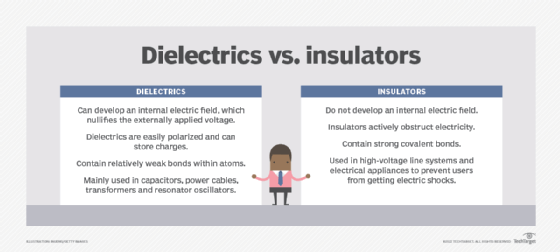
Dielectrics are often confused with insulators, although there are differences between these types of materials. For example, all dielectrics are insulators, but not all insulators are dielectrics. Some differences are highlighted in this graphic.
Applications of dielectric materials
Dielectric materials are used in numerous applications. Because of their ability to store charges, they are most commonly used for energy storage in capacitors and to construct radio frequency transmission lines.
High-permittivity dielectric materials are often used to improve the performance of semiconductors. In transformers, rheostats, shunt reactors and earth reactors, dielectric materials, such as mineral oils, act as cooling agents and as insulators.
Dielectrics are also used in liquid-crystal displays, resonator oscillators and tunable microwave devices. In some applications, specially treated dielectrics serve as the electrostatic equivalent of magnets. More recently, submerging data center hardware into a dielectric liquid cooling agent has been used to draw heat away from processing infrastructure to maintain a desirable ambient temperature.
See also: capacitor, picofarad per meter, flash storage, resistive RAM, floating gate transistor, inductor, ultracapacitor, transducer and liquid immersion cooling.